Intelligent Collections:
The New Standard
A modern, data-driven approach to delinquency management that helps banks, credit unions, and fintechs act earlier, work smarter, and deliver better outcomes—without sacrificing care.
What is Intelligent Collections?
Intelligent Collections improves efficiency and engagement at the same time. It is a modern, data-driven approach to managing delinquency that helps banks, credit unions, and fintechs act earlier, work smarter, and deliver better results across their portfolios—while creating a more supportive and convenient experience for account holders.
It brings together intelligent automation, an integrated ecosystem, digital self-service, data-driven prioritization, and AI-powered interactions so collections work moves faster, decisions are clearer, and every account is treated appropriately—not generically.
Instead of reacting to delinquency late in the cycle, Intelligent Collections gives your team the ability to anticipate risk, engage account holders on their terms, and resolve issues faster without adding strain to your collectors.
Who Uses Intelligent Collections?
Every organization starts at a different place, but all can apply Intelligent Collections to transform their approach to risk.
BANKS
seeking stronger default management through early-, mid-, and late- stage delinquency.
CREDIT UNIONS
wanting to support account-holder wellbeing while improving recovery.
FINTECH LEADERS
needing a scalable, modern collections model.
SERVICERS
looking to unify data, workflows, and communication across teams.
Why Does Intelligent Collections Matter?
Collections is where speed, judgment, and responsibility converge.
Behind every past-due account is a person navigating something unexpected—a job change, a medical bill, a month that slipped off track. At the same time, financial institutions must protect the portfolio, follow policy, and manage risk.
Legacy collections processes weren’t built for this reality.
Manual decisions, static workflows, and one-size-fits-all effort force teams to move fast in the wrong ways—working long queues, switching between systems, and repeating the same judgment calls. The result is activity without progress, inconsistent outcomes, and little room for care.
Efficiency That Enables Better Experiences
With intelligent automation and data-driven prioritization, the right accounts surface sooner. Next actions are clear. Policies are applied consistently. Collectors spend less time deciding what to do and more time resolving accounts.
That efficiency compounds:
EARLIER
Accounts are addressed earlier in delinquency.
FASTER
Teams resolve more accounts per day, per collector.
SMARTER
Managers gain visibility and control without micromanagement.
And when teams aren’t buried in manual work, conversations improve.
Efficiency isn’t the opposite of empathy. Efficiency enables empathy at scale. With context, confidence, and time, outreach becomes timely instead of reactive—and interactions feel more human and more respectful.
The Five Pillars of Intelligent Collections
Intelligent Collections is built on five connected pillars. Each one addresses a specific breakdown in traditional collections work. Together, they change how teams operate day-to-day-bringing speed, clarity, and consistency to the work, while making interactions more timely and more human.
1. Purpose Built Automation (Playbooks)
Clear direction at every stage of delinquency
Playbooks turn policies and strategies into action. They guide accounts through the right path at the right time, automatically adapting as risk, behavior, and status change. Instead of relying on memory or experience alone, collectors see clear next steps that reflect your policies and goals.
The result is consistency without rigidity. Teams move faster because decisions are already framed, managers spend less time correcting course, and account holders receive fair, predictable treatment—regardless of who touches the account or when.
Playbooks help you:
- Reduce manual effort and guesswork.
- Remove inconsistent handling of similar accounts.
- Trigger communication and tasks based on real behavioral signals.
- Give collectors more time to focus on meaningful conversations.
Automation doesn’t replace people. It empowers them with intelligent structure.
2. Integrated Ecosystem
One connected environment for collections work
Collections work breaks down when data and tools live in separate systems. An integrated ecosystem brings core banking data, loan information, payments, communications, and policies together in a single environment.
That connection keeps work moving. Collectors don’t lose time chasing information. Managers see what’s happening across the portfolio in real time. And strategies execute cleanly at scale—without handoffs, delays, or blind spots.
3. Digital Self-Service
Resolution that works on the account holder’s terms
Digital self‑service drives engagement by meeting account holders where they are, giving them timely, flexible ways to settle past-due balances without waiting for a call. Payment options, plan setup, and self‑cure opportunities are available when motivation is highest—not days later—so account holders can act on their own terms, through the channel they prefer.
For your team, that means fewer low‑value calls and more resolved accounts earlier in delinquency. For account holders, it means privacy, control, and less friction during a stressful moment. When resolution is easier, engagement improves naturally.
Intelligent Collections enables outreach and resolution through:
Phone and silent voice drops
Email
SMS/text
Digital chat
Self-service portals
When account holders can take action digitally, they engage sooner, respond faster, and self-cure with more confidence.
4. Data-Driven Prioritization
Focus effort where it makes the biggest difference
Not every account needs the same level of attention. Data‑driven prioritization uses risk signals, behavior patterns, and likelihood to self-cure to surface the accounts where action matters most—early and often.
Collectors spend less time sorting through queues and more time working accounts that benefit from intervention. Managers gain confidence that effort aligns with impact. And account holders aren’t overworked when time and options are enough to self‑cure.
5. AI-Powered Engagement and Portfolio Insight
Better decisions, supported in the moment
AI helps collectors discover what the data is already telling them. By clarifying next best actions or surfacing patterns across your portfolio, AI reduces the mental load of manual decision‑making and replaces guesswork with confidence.
Instead of toggling between systems or second‑guessing strategy, collectors move forward with context. They’re informed by behavioral signals, account history, and real-time data. Conversations are more relevant. Outreach is timelier. And managers can query their portfolio to uncover trends, risks, and opportunities that static reporting misses.
This doesn’t replace human judgment. It sharpens it and expands what your team can see. And that’s only the beginning. AI is already moving beyond the collector’s queue and into the digital channels and self-service experiences where account holders take action on their own terms. As these capabilities mature, every touchpoint in the collections process becomes smarter: outreach that adapts in real time, self-service that responds to context, and prioritization that gets sharper with every interaction. The institutions building AI into their collections model now won’t just keep pace with what’s coming—they’ll be ready to lead it.
From Legacy Collections to Intelligent Collections
Intelligent collections is fundamentally a different way of working.
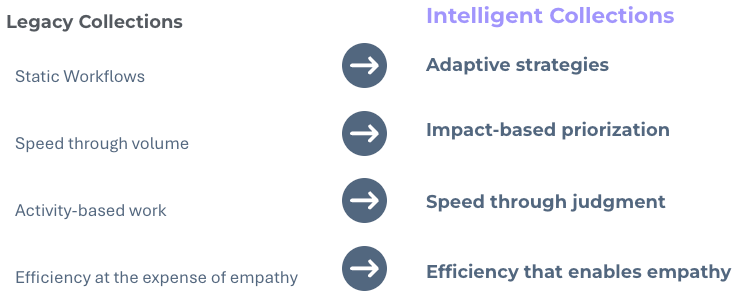
Progress, One Step at a Time
Intelligent Collections doesn’t require a big-bang transformation. Progress can start with better segmentation, automated work queues, or strategies that adapt as accounts change. Each step reduces noise, increases speed, and gives teams more space to do what only people can do, help account holders me forward.
That’s why banks, credit unions, and fintechs choose Intelligent Collections: to act earlier, work smarter, and bring more care to one of the most important moments in the account holder relationship.
Intelligent Collections Is the Standard for What’s Next
Delinquency isn’t going away. But the way financial institutions respond to it can—and must—change.
Intelligent Collections gives banks, credit unions, and fintechs the tools to act earlier, the clarity to work smarter, and the structure to bring real care to every account. It doesn’t ask teams to choose between speed and empathy. It makes both possible at the same time.
The shift from legacy collections to Intelligent Collections isn’t a single decision. It’s a direction—one that compounds with every playbook refined, every digital channel activated, and every collector freed from manual work to focus on what matters: helping account holders move forward.
AKUVO built Intelligent Collections to be exactly this: not just better technology, but a better way of working. One designed for the moment collections teams are in right now—and for everything that comes next.
Leave a Reply