Community First Credit Union Turned Live Operations Data into a Sharper Contact Strategy
Ten months of collections activity. Six channels.
One analysis that changed how the team invests in every account.

Payment Rate
Overview
Community First Credit Union runs a disciplined collections program. When the team made strategic changes to its contact mix, they wanted data to confirm the results, not assumptions. With ten months of live operations already captured in the AKUVO platform, CFCU had everything they needed: a channel-by-channel picture of cost, performance, and opportunity, ready to surface.
Key Takeaways
- Contact volume and contact quality aren’t the same thing. CFCU’s data revealed that a large share of outsourced outreach was landing in voicemail rather than reaching live account holders. Knowing the difference—and being able to act on it—is exactly what channel-level analytics makes possible.
- Zero-cost channels can outperform paid ones. Email outperformed every paid channel in CFCU’s data at zero additional cost. Before adding vendors, collections leaders should know what their existing tools are already capable of producing.
- Your highest-performing channel doesn’t work in isolation. CFCU’s contact model led with voicemail drops and texts before email. By the time email arrived, account holders had already been touched. Understanding what your data is actually measuring—channel performance or contact sequence—is what separates a finding from a strategy.
- Your data already knows where the opportunity is. CFCU didn’t run an experiment. They ran 10 months of normal operations. AKUVO surfaced what the data already contained: cost comparisons, performance by delinquency stage, and channel interaction effects that changed how they invested.
“We leveraged AKUVO’s analysis to refine our contact strategy and to clearly demonstrate the value of flexible technology with relevant integrations that produce meaningful results.”
Cary Shumway
Customer Approach
Between April 2025 and February 2026, CFCU ran its collections contact activity across six channels: third-party outreach, VoApps (silent voicemail drops), phone calls, email, text/SMS, and inbound calls. AKUVO captured and analyzed 148,018 contacts and 215,617 payment records across 24,932 unique accounts during that period.
This was not a controlled experiment designed to test channels against one another. It was ten months of live collections operations. What the data revealed was something more valuable: a clear picture of how each channel performed, what each one cost, and where the real opportunities were hiding.
Channel activity periods reflected CFCU’s evolving strategy over the year: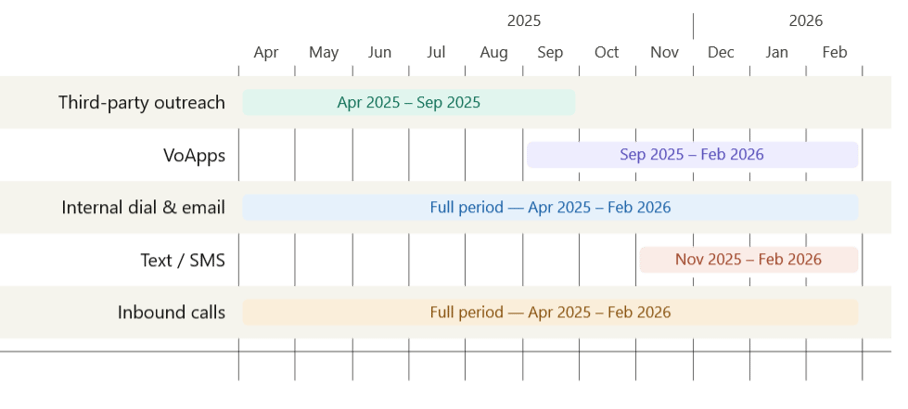
As CFCU’s strategy shifted—phasing out third-party outreach, introducing VoApps, and scaling email—the data captured each transition in real time. That timeline became the foundation for a set of findings that changed how CFCU thought about its contact model.
“With all of our data already in AKUVO, we avoided relying on multiple outside data sources and quickly identified the contact strategy shifts needed to improve collection results.”
Cary Shumway
Results
Channel Performance Analysis Revealed a Smarter Path to the Same Result
When CFCU analyzed third-party outreach contact data through AKUVO, a clear pattern emerged: the overwhelming majority of contacts weren’t reaching live account holders. Most were voicemails or unanswered calls—functionally the same result VoApps was delivering at a fraction of the cost.
When placed head-to-head across comparable delinquency stages, VoApps and third-party outreach produced nearly identical payment rates: 38.1% and 37.9% at seven days, respectively—a difference of less than one percentage point. The performance was equivalent. The cost was not.
By shifting third-party outsourced call volume to VoApps, CFCU could preserve live-contact capacity for the accounts that need it most—while saving more than $150,000 annually with no meaningful impact on recovery rates.
Email outperformed every paid channel—and costs nothing
At a 39.3% seven-day payment rate, email outperformed every other channel in the study—VoApps (38.1%), third-party outreach (37.9%), text/SMS (35.2%), and internal dial (34.5%)—at zero additional cost.
But those numbers come with context. CFCU’s contact model typically led with a voicemail drop and a text before email reached the account holder. Email's payment rate reflects the full sequence, not email alone. The right read isn't that email wins—it’s that the right combination, in the right order, drives results.
Both email and VoApps peaked at the 21-to-29-day window, reaching 48.3% and 48.7% respectively—the highest-performing delinquency stage in the data.
The Shift to VoApps Triggered a Broader Strategy Change—and the Data Captured Both
On October 1, 2025, CFCU transitioned from its third-party outreach vendor to VoApps. But the shift wasn’t just a vendor swap. It was a strategic reorientation.
In the months prior, the third-party vendor had been sending roughly 3,123 contacts per week. After the switch, VoApps volume was 1,023 per week—about a third of the previous volume. Simultaneously, email volume nearly doubled, rising from 652 to 1,316 sends per week.
When AKUVO’s analysis isolated the performance drivers, the picture became clear: VoApps and the third-party channel perform equivalently in isolation. It was the surge in email volume—not the vendor change alone—that drove the improvement in overall payment rates after October. Email payment rates improved from 20.7% to 25.3% following the transition, and that lift, combined with twice the volume, made email the primary engine of better results.
VoApps combined with email produced a 4-day payment rate of 26.8%. The third-party channel combined with email produced 23.7%. The channel mix mattered as much as any individual channel.
Conclusion
What Community First Credit Union built over ten months wasn’t just a cost-reduction project. It was a data foundation—and the findings pointed to several immediate opportunities to improve cost efficiency and contact strategy without increasing headcount or adding new technology:
-
Shift remaining outsourced call volume to VoApps. With less than 1% performance difference and a 140-to-1 cost advantage, the case is clear. Live-contact capacity freed up by this shift can be redirected to higher-risk accounts where human conversation justifies the cost.
-
Expand VoApps and email coverage at 21 to 29 days past due. This is the highest-performing delinquency window in the data, with payment rates approaching 50% for both channels—yet it currently receives only about 10% of contact volume. Routing more accounts here at less than 1% of the cost is the highest-return adjustment available.
-
Fine-tune templates at peak delinquency stages. Email and VoApps both peak at the 21-to-29-day window. Optimizing message content for that specific stage—where payment rates approach 50%—compounds the return on channels that are already performing.
CFCU already knew their contact strategy needed refinement. The data helped them fine-tune it—confirming what was working, identifying where to invest, and giving the team a channel-by-channel picture of cost and performance they didn’t have before. With all of that already in the AKUVO platform, acting on the findings didn’t require outside help or new tools. Just a clearer read on what was already there.
The platform doesn’t prescribe a single right answer. It gives collections leaders the data to find their own. For CFCU, that meant confirming two things they already suspected: email was the highest-performing channel in the mix, already built into the platform at no cost, and VoApps was delivering equivalent voicemail results for a fraction of what third-party outreach had been costing.
That kind of clarity changes how a team works. Not by adding pressure, but by removing it.